


Shaft seals with PTFE sealing lip
Shaft seals with PTFE sealing lip have been specially developed for use in difficult and extreme conditions. They are used when shaft seals with classic elastomer lips reach their performance limits.
Due to the almost universal chemical resistance of PTFE compounds, seals with PTFE sealing lip are particularly suitable for use with chemical, aggressive and corrosive media, pharmaceutical products, various coolants, synthetic oils, heat transfer oils, water and steam.
Thanks to the outstanding properties of PTFE materials and the optimized lip designs, shaft seals with PTFE sealing lip have the following advantages:
- Applicable in a wide temperature range from -70°C to +260°C
- Lowest friction and power consumption due to favorable sliding properties
- Almost universal chemical resistance
- Can be used for dry running and lack of lubrication
- No stick-slip effect, thus low breakaway torque even after longer interruptions
- High circumferential speeds, up to 30 m/s possible
- Pressure load up to 10bar possible
- Use in the food and pharmaceutical industry

We are known as a problem solver in the field of shaft seals. Every application is tested and evaluated by our technical department on the basis of years of experience in order to provide the best possible solution for your application.
General technical information, applications and industries Shaft seals with PTFE sealing lip
The sealing quality and service life of a shaft seal depend to a large extent on the surface condition of the countersealing surface. The countersealing surfaces must not show any scratches or dents. The same applies to the shaft areas over which the seal is drawn until it is positioned. The areas to be sealed must be free of dust. The shaft may be greased for assembly if the application permits. The grease must be free of solids, e.g. MoS2 or ZnS, and have the appropriate temperature resistance (incl. the resulting frictional heat).
Note:
The operating parameters such as pressure, temperature and speed influence each other. A simultaneous occurrence of the maximum parameters mentioned is therefore not permissible. Please contact our engineering department in such cases.
The locating bore
The shaft seal ring with PTFE sealing lip is pressed into the locating bore.
Bore tolerance H8
Ra <1.6 µm
Insertion chamfer 1.5 ±0.2 x 20° (- 25°)

Typical applications / industries
They can be found for example in:
- Compressors
- Shaft and pump sealings
- Mixers
- Agitators
- Gearboxes
- Centrifuges
- Machine tools or in blowers
The shaft
Shaft seals with PTFE sealing lip ideally run on hard mating surfaces to prevent run-in marks in the shaft. An ideal mating surface is for example the hard chrome-plated running surface. To generate a better match between sealing and mating surfaces, we recommend subjecting these surfaces to a short running-in process.
Our recommendations for the design of the running surface:
Shaft tolerance: h11
Hardness: ideally at least 60 HRC
Surface finish: Ra 0.2 - 0.4
Twist-free groove ground
Lead-in chamfers at shaft end

Shaft sealing rings must be fitted extremely gently to avoid damage to the sealing lips.
We recommend using press-fit rings for assembly. We are also happy to offer the matching press-fit rings for the shaft seals.


Mounting tools
If shaft seals are mounted against the sealing lip on shafts without sufficient lead-in chamfer, or if they have to be pushed over grooves or transverse bores, we recommend using suitable mounting tools.
These tools must not have any sharp edges or transitions. They must have the same surface quality as the recommended mating surface.
We are also pleased to offer the appropriate mounting tools for the shaft seals.


Eccentricity
To prevent the sealing lip from lifting off the shaft, the shaft runout must be low.
We therefore recommend a concentricity tolerance of maximum 0.05 mm.
Coaxiality
There must be uniform radial contact pressure over the entire circumference of the sealing lip on the shaft to prevent uneven wear.
We recommend a maximum coaxiality of 0.1 mm.
Load
The load on the shaft seal during operation depends mainly on the pressure and the circumferential speed of the shaft. How far the shaft seal is from its load limit, or whether this has been reached or exceeded, can be determined by looking at the pv value. The permissible pv value is shown by the curve in the diagram.
In the case of dry running/lack of lubrication, the value can be greatly reduced.
In this case, please contact our technical department.
 The curve shown is valid for type M01 in oil bath
Material selection
In addition to the correct choice of design and sealing lip geometry, the correct selection of the lip material is also decisive for the service life. PTFE materials are used as standard and their advantages can cover a wide range of applications.
Sealing lip materials
The following PTFE materials are available as standard for shaft seals in stainless steel housings:
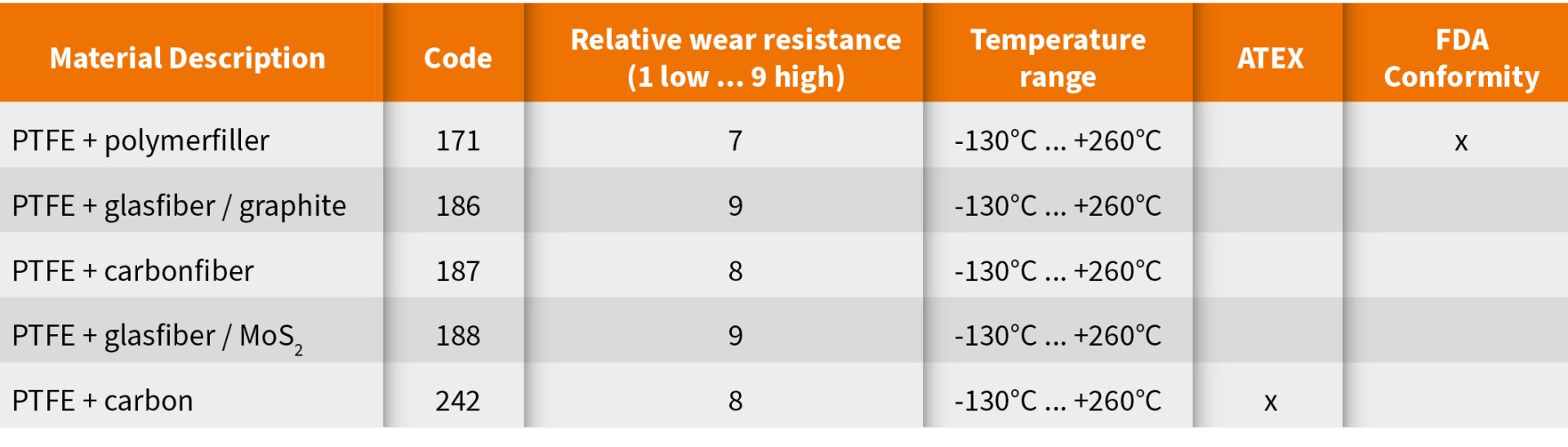
Housing material
The housing is made of stainless steel 1.4301 (ss 304). Alternatively it is also possible in 1.4401 (ss 316)
Match code for rotary shaft seals with stainless steel housing

The following information is required for the seal definition of the shaft seal:
Example
RWDR - (type) - (groove dimension) - PTFE material
Shaft seal types with stainless steel housing
The sealing lips are set in a corrosion-resistant stainless steel housing which is pressed into the location bore. The bore should therefore be made of steel or cast iron. The dimensions of the sealing rings are comparable with shaft seals to DIN 3760 and can therefore be easily replaced.

Type M01
Standard seal with supported sealing lip
Application limits:
Temperatures: -40°C - +260°C
Max. Pressure: 10 bar
Max. Peripheral speed: 30 m/s
Example: Compressors, mixers, agitators, gearboxes, vacuum pumps

Type M
With straight metal housing.
Example: Compressors, agitators, planetary gearboxes, compressors
Type M04
With negatively shaped sealing lip. Ideal for applications where no dead spaces are permitted, for example in the food and pharmaceutical industries.
Example: Planetary gearboxes, filter centrifuges, dryers, centrifuges, agitators

Type MOD
Shaft seal pressed onto shaft, seals at the bore.
Example: Centrifuges

Type MD
For applications where a higher sealing effect is required, such as e.g. gaseous or critical media.
Also offers the possibility to fill the gap with a disposable lubricant.
Example: Vacuum pumps

Type MF
Spring-energized sealing lip for increased tightness requirements to allow better lip tracking at low shaft runout.
The spring increases the standstill tightness in pressureless condition.
Example: Pumps

Type MW
With scraper lip, which prevents abrasive particles from depositing under the sealing lip. Ideal for dusty and dirty environments.
Example: Radial piston pumps, granulating systems, mixers

Type MD12
Two opposing sealing lips for separation of two different media with support disc between the lips.
Example: Grinding machines, agitators
In addition, we offer further individual solutions to shaft seals with PTFE sealing lip in stainless steel housing in order to be able to offer an even better adaptation to customer-specific applications.
The following is an excerpt from our range of designs:

Type MS Scraper seal
Scraper seal with a scraper lip made of stainless steel or brass and a sealing lip made of wear-resistant PTFE. Removes adhering dirt or ice particles.
Example: Lifting rod seal

Type MPS
Shaft seal with inserted packing cord made of PTFE (also FDA compliant possible).
Example: Shaft bushings on industrial furnaces, crankshafts and gearbox shafts, protection for bearings and drive units, as a special design up to 430°C for high-temperature applications.
Note:
All shaft seals can also be manufactured in a low-friction version. Likewise the respective medium lip can be equipped with a return thrust.
However the running direction of the shaft must be known beforehand.
We stock many common dimensions of the standard type M01. In addition, we manufacture these rings in any intermediate dimensions.
Seals up to shaft diameter Ø 470 mm are possible.


Shaft seals without housing
Shaft seals without housing are individual solutions that do not require a stainless steel housing. This allows a larger diameter range from Ø 1.5 - Ø 3000 mm.
Furthermore, the production of smaller lot sizes is possible and can also be manufactured in many special compounds at short term.
In addition to the classic formed sealing lip, the lip can also be equipped with a spring which, among other things, ensures that the contact pressure of the lip on the shaft remains constant even in the event of temperature fluctuations.
For designs without dead space, the spring space is filled with red silicone (FDA) after spring assembly. Some applications even allow the use of an O-ring as a preload element of the sealing lip and simultaneous dead space solution.
This type of seal without a stainless steel housing is also pressed into a location hole. Unlike the shaft seal with stainless steel housing, however, this does not always have to be made of steel or cast iron. The locating bore can also be made of plastic.
An elastomer O-ring is fitted to the outer diameter of the sealing ring, which provides the static seal between the sealing element and the bore.
We recommend clamping the shaft seals axially to prevent them from rotating.
The areas of application conform to the shaft sealing rings with stainless steel housing.

RWDR oG M
Standard type, suitable for a wide range of applications.
Example: Rotating unions, pumps

RWDR oG MD
The double-lipped design offers more safety with more critical media.
Example: Screw conveyors, mixers, agitators

RWDR oG 400
This version has a spring-energized sealing lip.
Example: Drum motor, parts cleaning machines

RWDR oG 4VSSR
The spring space is additionally filled with red silicone. This prevents product from accumulating in the groove or germs from entering the spring spaces.
Example: Mixers, agitators for the food industry

RWDR oG MW400
This design has a spring-energized main seal lip with a dust lip to prevent ingress of debris.
Example: Back-up roller seal, mixers, agitators
In addition, we offer further individual solutions to shaft seals with PTFE sealing lip without stainless steel housing, in order to be able to offer an even better adaptation to the customer-specific applications.
Excerpt from our range of types:

Solution with steel band insert
Prevents sinking of the pressing load in the bore, in cold environment.

Solution with a clipped-in steel ring to hold the shaft seal in the bore by press fit.

Solution with an outer and inner jacket made of steel. This allows an interference fit to be realized on the outside. The inner ring prevents the PTFE material from shrinking onto the shaft in a cryogenic environment.
Materials
 The given specification regard material conformity are only valid if individual confirmed by GFD. All application parameters has to checked and confirmed in each individual case.
O-Ring description

Spring material

The abbreviations C I E R refer to the last digit of the match code.